


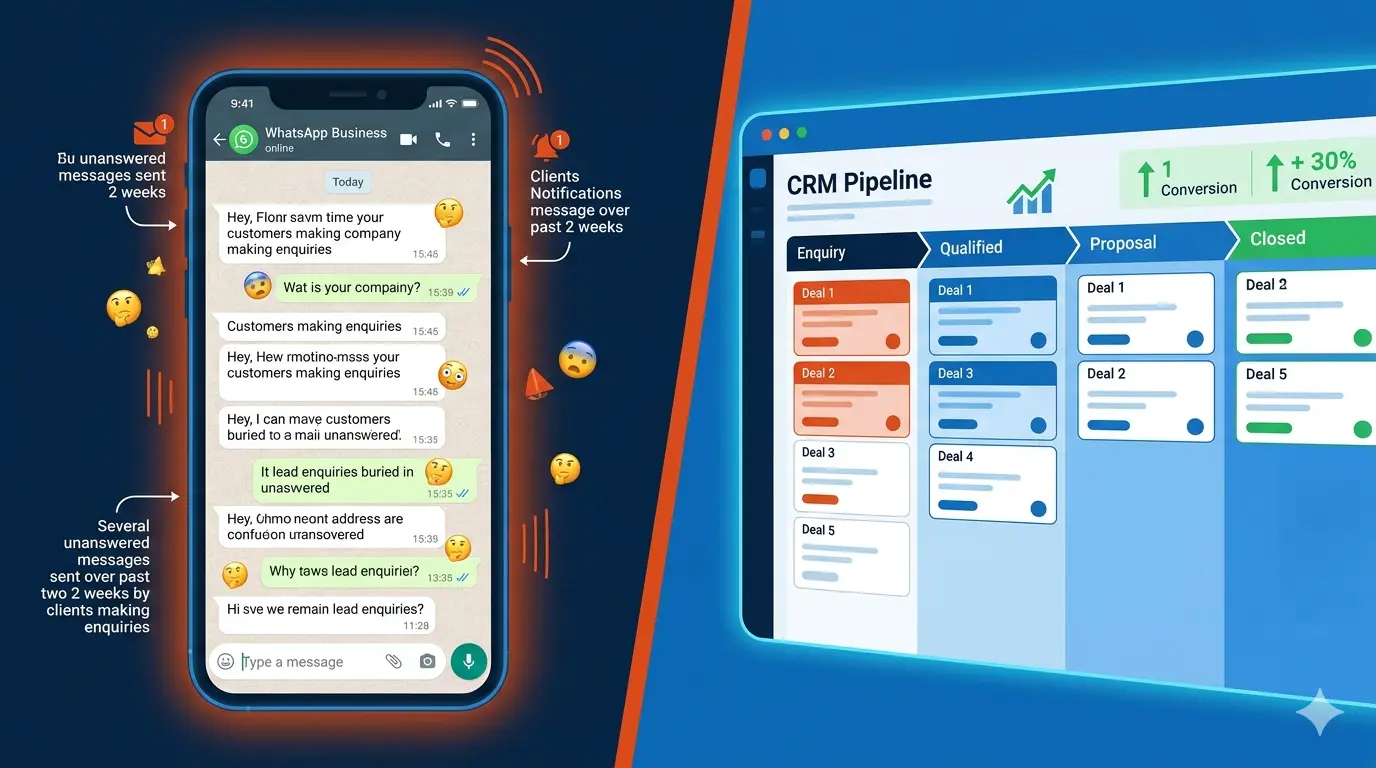

A sales manager at a Lagos-based financial services company told me: “We manage all our leads on WhatsApp. When a new enquiry comes in, it goes into a group chat. Someone picks it up. We follow up from there.”
I asked: “How many leads came in last month?” He said: “Maybe 30. I am not entirely sure.”
I asked: “How many converted to clients?” A pause. “I would need to check with the team.”
I asked: “What happened to the ones that did not convert?” A longer pause. “I honestly could not tell you.”
This is not an unusual conversation. It is the default reality for a significant number of Nigerian businesses managing sales activity through WhatsApp groups, personal phones, and memory. And every day it continues, it is costing real money.
Why WhatsApp Became the Default Sales Tool
WhatsApp Business is genuinely excellent for communication. It is instant, it works on every phone, and virtually every Nigerian professional is already using it. When a business starts small, it is a reasonable way to manage a handful of customer interactions.
The problem is that businesses keep using it long after it has stopped being fit for purpose. WhatsApp was built for messaging. It was not built to track deals, record decision histories, attribute leads to sources, or give management visibility into sales activity. When you use it for these purposes, you are asking a messaging app to do the work of a business system.
6 Ways WhatsApp-Based Sales Management Costs Nigerian Businesses
1. Leads fall through the cracks silently
A lead sends an enquiry. It lands in the group chat. The team is busy. The message scrolls up. Two days later, nobody remembers. The potential client has signed with a competitor. You will never know this happened because there is no record the lead ever existed.
Research consistently shows that responding to a lead within one hour makes a business 7 times more likely to convert. On WhatsApp with no automation, response time depends entirely on who happens to see the screen.
2. You have no pipeline visibility
Pipeline visibility means knowing at any moment how many deals are in progress, which stage each one is at, what the next action is, and what your projected revenue looks like for the next 30 days. None of this is possible when your pipeline exists across 12 WhatsApp conversations and several people’s personal phones.
3. Departing staff take client relationships with them
Every conversation your sales team has with a client on WhatsApp is stored on their personal phone. When they resign, everything goes with them. Three years of relationship-building, context, and communication history — in a personal device your business has no claim to.
4. Follow-up is inconsistent and personality-dependent
In a WhatsApp-based system, follow-up happens when individual team members remember to do it. Some people are disciplined. Others are not. The quality of your customer experience and conversion rate varies wildly based on which sales person picked up the lead — not because of any deliberate system.
5. You cannot measure what is working
Which channel generated the most leads last month? Which ones converted at the highest rate? Which team member has the best close rate? What is your average time from enquiry to close? These questions cannot be answered from WhatsApp. Without answers, you cannot improve what you cannot measure.
6. Scaling is impossible
Managing 10 leads on WhatsApp is challenging but survivable. Managing 100 is chaos. The WhatsApp-based sales system has a hard ceiling: the moment your lead volume exceeds what your team can hold in their heads, the system begins collapsing under its own weight.
| Problem on WhatsApp | What Zoho CRM Does Instead | Business Impact |
|---|---|---|
| Leads fall through the cracks | Every lead captured and assigned with automatic follow-up task | Zero leads lost to forgetting |
| No pipeline visibility | Live dashboard — every deal, stage, and next action | Management sees the full picture in real time |
| Staff take contacts when they leave | All data owned by company not individuals | Business continuity regardless of staff changes |
| Inconsistent follow-up | Automated reminders, task creation, and escalation rules | Consistent process for every lead every time |
| Cannot measure performance | Full reporting — source attribution, conversion rates, team performance | Data-driven decisions replace gut feeling |
| Cannot scale | System handles 10 or 10,000 leads with the same discipline | Growth without proportional chaos |
How iLLuSys Implements Zoho CRM
- Discovery session — map your current sales process, stages, and team structure
- Pipeline build — create custom sales stages based on how your business actually sells
- Lead capture integration — website forms, Meta Ads, and landing pages feed directly into CRM
- Automation setup — follow-up tasks, email sequences, and escalation alerts configured for your process
- Custom fields — any information specific to your business captured against every lead
- Dashboard configuration — management visibility into pipeline health and revenue forecast
- WhatsApp integration — conversations logged against the right contact in CRM
- Staff training — your sales team trained with practical exercises
- 30-day hypercare — iLLuSys monitors and adjusts through the bedding-in period
Proven With Nigerian Businesses
- ISP Education — 4 years of ongoing Zoho CRM management
- Trustcrow Digital Nigeria — full sales and marketing tech stack throughout 2025
- Malexchlo Global — CRM and operations management from March 2026
Read the Trustcrow case study: illusys.com.ng/work-done/trustcrow
Frequently Asked Questions
Can we still use WhatsApp after setting up Zoho CRM?
Yes. Zoho CRM integrates with WhatsApp Business API. Conversations on WhatsApp can be logged automatically against the relevant contact in your CRM. You keep the communication channel. You gain the system behind it.
How long does implementation take?
A standard Zoho CRM implementation for a Nigerian SME takes 2-4 weeks from kickoff to go-live.
What if my team resists using a new system?
iLLuSys addresses adoption through practical training focused on how the CRM makes each individual’s job easier. Mobile app setup dramatically improves adoption rates because the team can use it from their phones.
Stop losing leads to WhatsApp. Book a free CRM strategy call with iLLuSys today.
Chat with us: wa.me/2349110079195