



Here is a conversation I have regularly with Nigerian marketing managers.
We ran a Facebook campaign last quarter. Got a lot of leads. Spent about 300,000 naira on ads.
I ask:
“How many of those leads became paying clients?”
Pause.
“I would need to check with sales.”
I ask:
“What was your cost per acquired client?”
Longer pause.
“We do not really track it that way.”
I ask:
“So how do you decide how much to spend on Facebook ads next quarter?”
The answer:
“Based on what we did last time, and whether the CEO approved the budget.”
This is not a marketing problem. This is a data connectivity problem. And it is almost universal among Nigerian SMEs running marketing activities without a connected technology stack.
The Problem: Your Marketing Data Lives in 5 Different Places
- Meta Business Manager — ad spend, reach, clicks, leads from Facebook and Instagram
- Google Analytics or GA4 — website traffic, page views, session data
- Mailchimp or similar — email open rates and click rates
- A spreadsheet — manually compiled lead list from various sources
- The sales team’s memory — what happened to those leads after they came in
None of these tools talk to each other. You have activity data everywhere but cannot connect activity to outcome. You cannot answer the only question that actually matters: which marketing activity generated paying customers?
Why This Matters More Than Most Businesses Realise
- Continuing to spend on channels that look active but do not generate revenue
- Cutting channels that appear low-volume but close at high rates
- Inability to calculate real customer acquisition cost
- Marketing and sales teams working in silos, blaming each other for underperformance
- No ability to forecast revenue from marketing investment
What Connected Marketing and Sales Data Looks Like
Every lead is tagged with its source at entry
Whether a lead came from Facebook, Instagram, Google, a blog post, or a referral — that information is captured automatically and attached to every contact record in your CRM. Not manually. Automatically. Every time.
Marketing sees what happens to leads after they convert
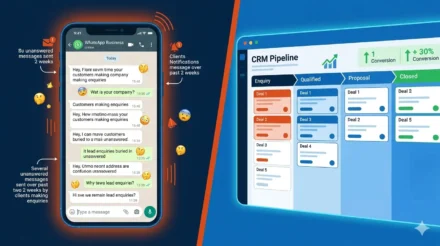
Instead of sending leads to sales via WhatsApp and never hearing about them again, your marketing team can see inside the same platform whether their leads moved through the pipeline, stalled, or closed. This closes the feedback loop that almost no Nigerian marketing team currently has.
You can calculate real campaign ROI
If your Facebook campaign generated 40 leads, 12 of which became clients at an average contract value of 500,000 naira, the campaign generated 6,000,000 naira in revenue against a 300,000 naira spend. That is a 20x return. You can see this number. You can use it to make the next budget decision.
Automated nurture keeps leads warm between conversations
Not every lead is ready to buy on day one. With Zoho Campaigns connected to Zoho CRM, leads not yet ready to buy are automatically enrolled in email nurture sequences — receiving relevant content over weeks or months until they are ready. No manual effort required.
| Marketing Activity | Captured in CRM | What Sales Team Sees |
|---|---|---|
| Facebook or Instagram ad | Lead name, email, phone, ad campaign name | Which campaign the lead came from |
| Blog post visit | Contact tracked if already a known lead | Pages visited and topics of interest |
| Email campaign open | Open tracked against contact record | Lead engaged with email before the sales call |
| Webinar registration | Attendance and engagement data | Lead showed buying intent before purchase |
| Landing page form fill | All fields captured and tagged to source | Full context available before first contact |
Case Study: How Trustcrow Ran Integrated Marketing and Sales in 2025
iLLuSys built and managed the complete marketing and sales technology stack for Trustcrow Digital Nigeria throughout 2025. This included Zoho CRM for lead management, Zoho Marketing Plus and Zoho Campaigns for email and campaign management, Zoho Landing Pages for product launches, UTM tracking across all paid channels, and a weekly leadership dashboard showing leads by source, stage, and conversion rate.
The result: a clear picture of which channels were generating qualified leads, which campaigns had the best cost per client, and where follow-up was breaking down in the pipeline.
Read the full case study: illusys.com.ng/work-done/trustcrow
What the Implementation Covers
- Audit your current marketing tools and data sources
- Configure Zoho CRM with your custom pipeline, fields, and tags
- Set up Zoho Marketing Plus with your brand, templates, and contact segments
- Connect your website forms, landing pages, and ad platforms to CRM
- Configure UTM tracking so every campaign is tagged and attributable
- Build your first automated nurture sequence for new leads
- Create your marketing-to-sales reporting dashboard
- Train your marketing and sales teams on the connected system
Get a free MarTech audit. We will review your current setup and show you exactly what is missing.
Chat with us: wa.me/2349110079195